
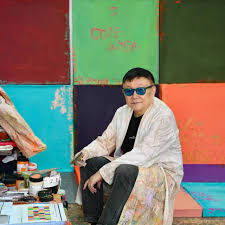
Ni Zhiqi (b. 1957, Shanghai, China) furthered his studies in the 1990s, at the Royal Academy of Fine Arts in Belgium, where he was awarded the first-class prize in the exhibition by Karel Veslat. He currently lives and works in Shanghai.
Ni Zhiqi’s recent colour-block works mainly belong to his Vacuum series, along with related mixed-media works such as World Theatre.
Vacuum Series (Representative Colour-Field Paintings in Recent Years)
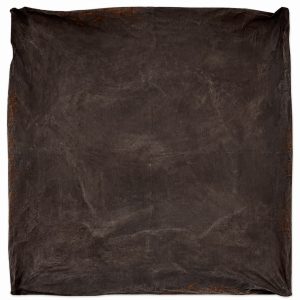
The Vacuum series represents an important stage in Ni Zhiqi’s artistic development, marking his transition from figurative representation towards a more purified form of abstraction. The works are characterised by expansive areas of colour, simplified geometric structures, soft boundaries, and rich surface textures. Although the compositions appear minimal, they are not cold abstractions in the Western modernist sense. Instead, they continue the artist’s long-standing exploration of memory, time, and perception.
Ni’s artistic approach is not simply about “painting colours”; rather, he uses colour to construct a psychological and emotional space.
Colour blocks = distilled fragments of reality
Throughout his earlier series, including Scenery, Windows, and Portraits, Ni has continuously explored a transformation from the concrete to the abstract. His abstraction does not completely depart from reality; instead, it simplifies and extracts the essence of specific objects and experiences. In this sense, the colour blocks in his recent works can be understood as traces left behind by lived experiences and visual memories.
Boundaries = the uncertainty of memory
The colour fields in Ni’s works often avoid sharp or definite divisions. Through subtle transitions, overlapping layers, and textured surfaces, the boundaries between forms become blurred. This visual quality continues the artist’s long-standing pursuit of a misty and translucent atmosphere — as if the world is being viewed through frosted glass or filtered light.
Colour = emotions accumulated through time
Ni frequently employs muted tones, earthy hues, and faded colours. Rather than the bright, pure colours often associated with modernist abstraction, his palette resembles the tones of aged walls, weathered paper, architectural fragments, and naturally eroded surfaces. Through these colours, the artist reflects on how time transforms and leaves traces upon material existence.
World Theatre Series
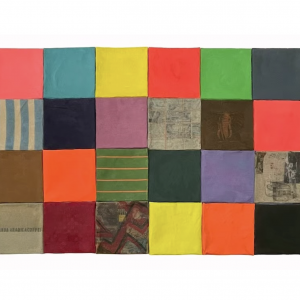
Another group of works closely related to his colour-block compositions is the World Theatre series. These mixed-media paintings consist of 32 monochromatic square colour blocks, inspired by the artist’s observation and refinement of everyday experiences.
The series can be understood as:A process of dismantling the world into countless visual fragments, and then reconstructing them into a new spiritual space.
Each colour block resembles:
· a fragment of memory;
· a moment accumulated through time;
· a trace of a city or personal experience.
Once reassembled, these fragments no longer represent specific objects or scenes. Instead, they form an abstract structure that reflects a broader meditation on existence, perception, and the passage of time.