
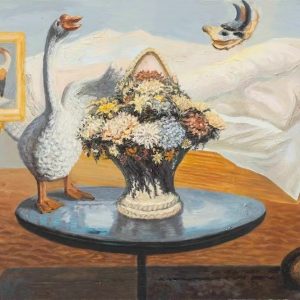
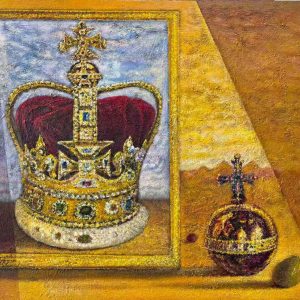
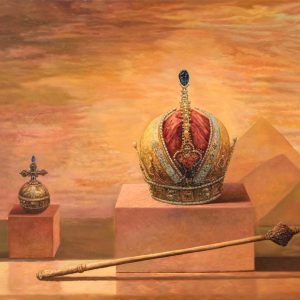
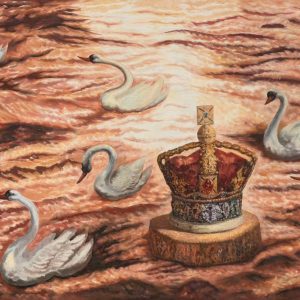
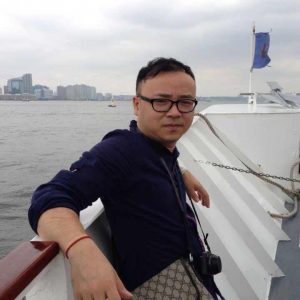
He Jie was born in Hunan in 1977. In 2000, he graduated from the Oil Painting Department of the Luxun Academy of Fine Arts with a bachelor’s degree, and in the same year began teaching at the affiliated high school of the academy. In 2005, he received a master’s degree from the Oil Painting Department of the same institution. He currently works and lives in Beijing. He serves as a Visiting Professor and Master’s Supervisor in the Department of Experimental Art at Lu Xun Academy of Fine Arts.
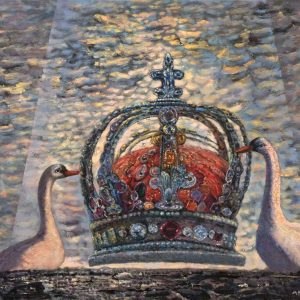
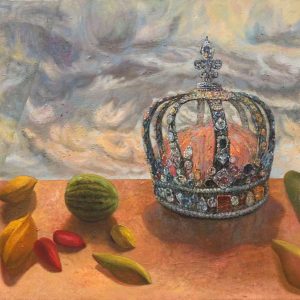
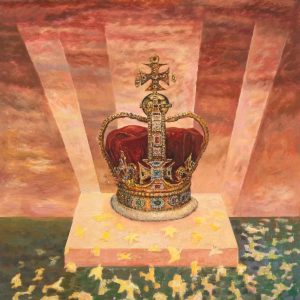
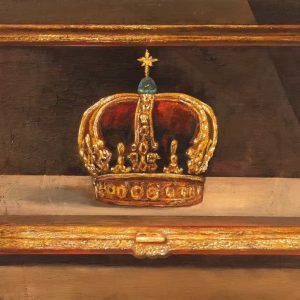
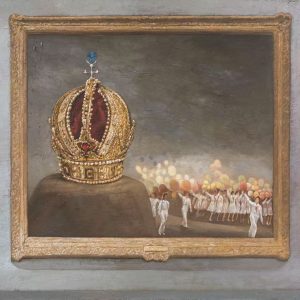
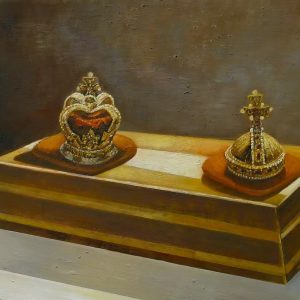
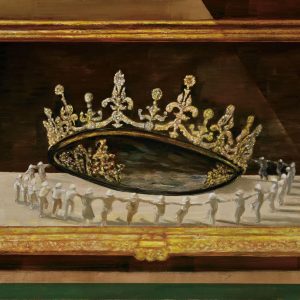
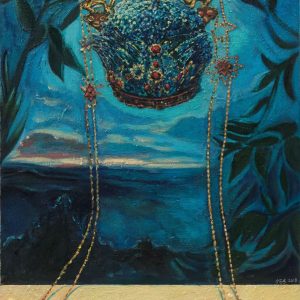
The Crown: A Symbol of Self-Recognition – A crown traditionally symbolizes glory, achievement, status, and dignity. Yet a true crown is not necessarily bestowed by others; it can arise from one’s recognition of the journey one has travelled. Every effort made, every moment of perseverance, and every choice along the way ultimately becomes part of one’s own “crown.”
His paintings engage with history, sociology, personal memory, and reflections on social values. Through his practice, the artist seeks to directly reveal the results of his own contemplation on society.
Nearly all of He Jie’s works in recent years have explored the aesthetics of those occupying positions of power within hierarchical structures, unfolding layered analyses around the many “seductive” dimensions of power. In this process, he draws upon both the artist’s innate sensitivity to sensual appeal and the intellectual’s critical awareness of social questions.
From the vast world of images, he selects scenes and objects that flaunt the authority, status, prestige, and influence of the powerful. The creators of these spectacles and symbols carefully manipulate the energies of aesthetics so that the words, actions, and ideologies of those in power become imbued with sensual attraction. The more sophisticated these aesthetic strategies of enchantment become, the more invisible their mechanisms appear, making visually intentional productions seem natural and inherent, as though they were born that way. As one visual producer understands another best, He Jie, himself a maker of images, appropriates these visual materials into his paintings. Through various methods that generate psychological unease, he seeks to disenchant or decode these visual products, enabling viewers to intuitively perceive and comprehend their hidden structures.
Grandeur, solemnity, and overwhelming spectacle are among the favored aesthetic tastes of the powerful, while meticulously choreographed rituals serve as the catalyst for such aesthetics. He Jie removes certain elements from these highly ceremonial scenes, or relocates symbolic objects into entirely new contexts. In doing so, the formal structures carefully constructed by the producers of power aesthetics are altered, generating complex layers of meaning. On the one hand, once the integrity of the structure is disrupted, its charm dissipates or becomes distorted, sometimes even taking on a satirical sense of humor. On the other hand, when certain objects and props that still retain aesthetic allure are placed into new settings, the once deeply convincing and mesmerizing behaviors and ideologies that captivated entire cultural communities are rendered hollow by the new context. What remains for the viewer is less admiration than reflection and contemplation on the passing of time and shifting values.
— Critic Du Xiyun