
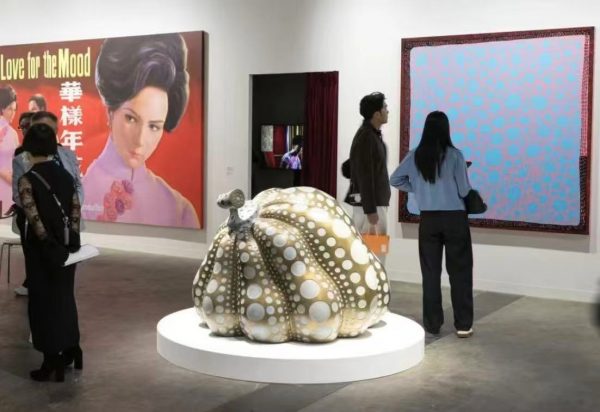
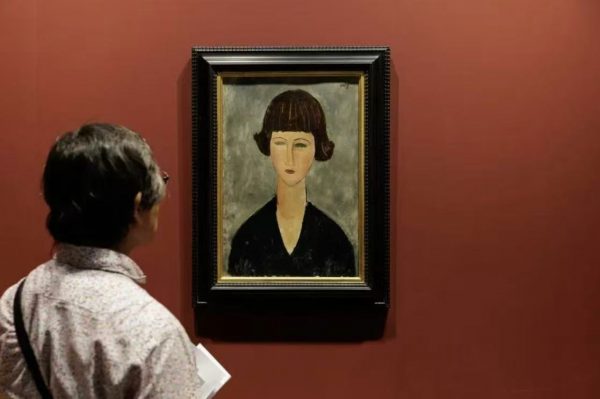
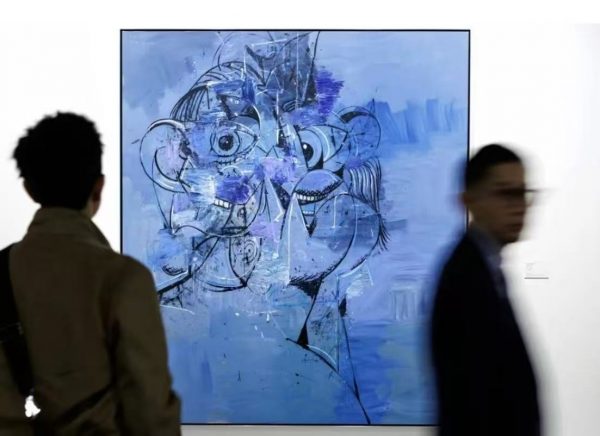
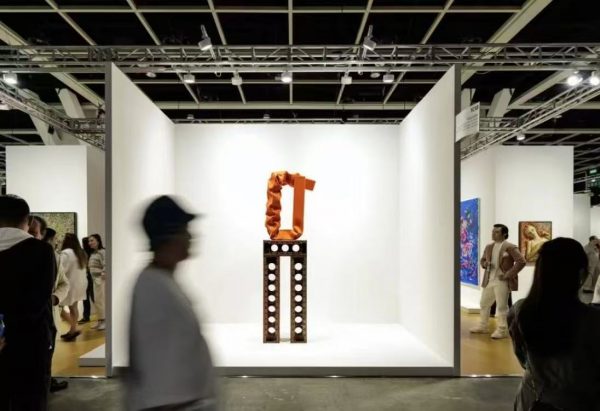
From Chuang Che’s 1960 ink experiments drifting between abstraction and landscape, to Huang Yuxing’s electrified, data-driven subterranean universe, these twelve remarkable works trace a spectrum of creativity that spans generations and geographies. Rooted at times in personal trauma and bodily narratives, and at others anticipating the deep convergence between technology and the human form, they collectively point to a singular reality: within the Hong Kong fair, contemporary art asserts itself through multiplicity and bold experimentation—extending an irresistible invitation to every viewer.
Pipilotti Rist
Sophie, The Enlightened Granddaughter (2025)
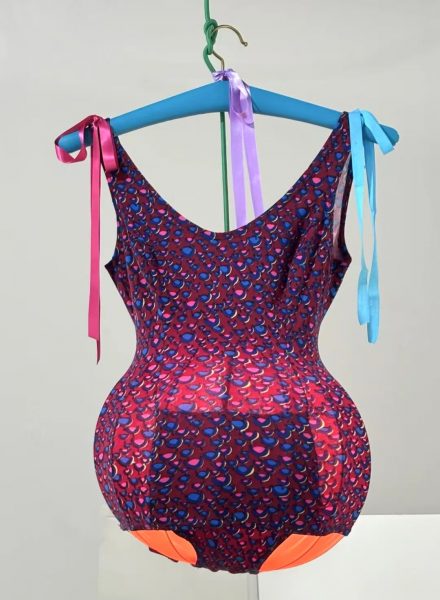
Pipilotti Rist’s luminous sculpture Sophie, The Enlightened Granddaughter (2025) is built upon a woman’s swimsuit stretched over a lampshade and adorned with shimmering ribbons. It evokes a character from the Swiss artist’s immersive visual universe—vivid, ethereal, and playfully irreverent.
Renowned for her sensory environments of light and sound, Rist here transforms an everyday object into a whimsical anthropomorphic presence.
Haegue Yang
Sonic Fabric over Brass Plated Web (2015)
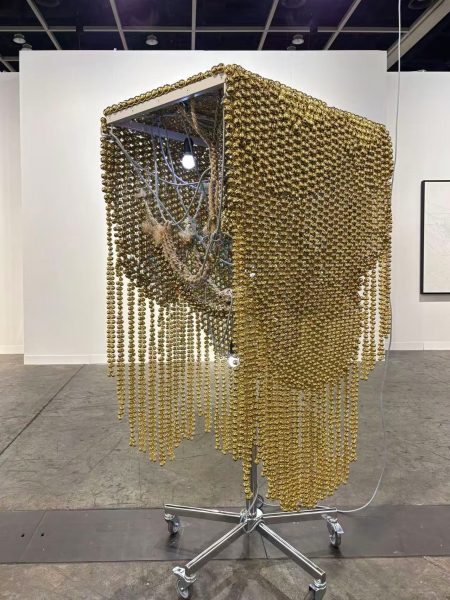
One of Korea’s most acclaimed contemporary artists, Haegue Yang transforms industrial materials—Venetian blinds, drying racks, metal frameworks—into intricate spatial compositions.
In this work, hundreds of small brass bells hang from a metal structure, forming what the title suggests: a shimmering “sonic fabric.” Mounted on wheels and interwoven with wires and light bulbs, the sculpture feels as if a passing breeze could set it gently ringing.
Sopheap Pich
Stalk 4 (2025)
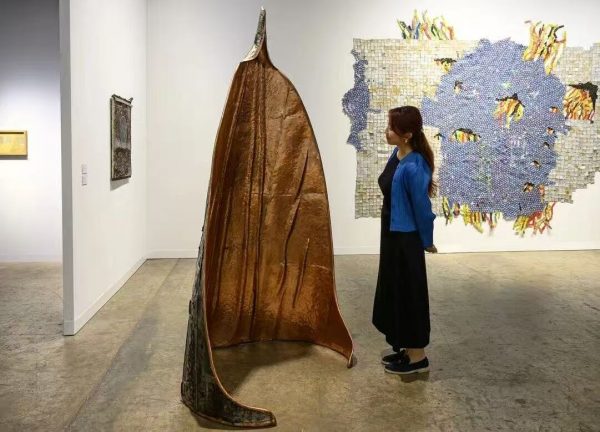
After returning to Cambodia in 2003, Sopheap Pich shifted from painting to sculpture, working with local materials such as bamboo, rattan, burlap, beeswax, and metal.
Stalk 4 (2025), made of aluminum and copper, rises in a narrowing curve reminiscent of a bamboo shoot—reflecting the artist’s ongoing exploration of organic forms like seeds, pods, and growth.
Chuang Che
As Lofty as a Mountain (1960)
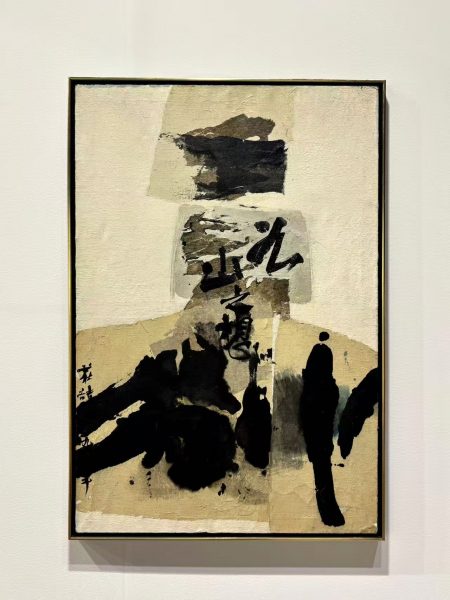
Created during a pivotal moment when artists sought to redefine Chinese painting, Chuang Che—alongside the Fifth Moon Group—introduced Western abstraction into dialogue with ink traditions.
This work hovers between landscape and abstraction: washes and gestural strokes suggest mountainous forms without ever rendering them explicitly.
Udomsak Krisanamis
Tangle Up Tango On (2025)
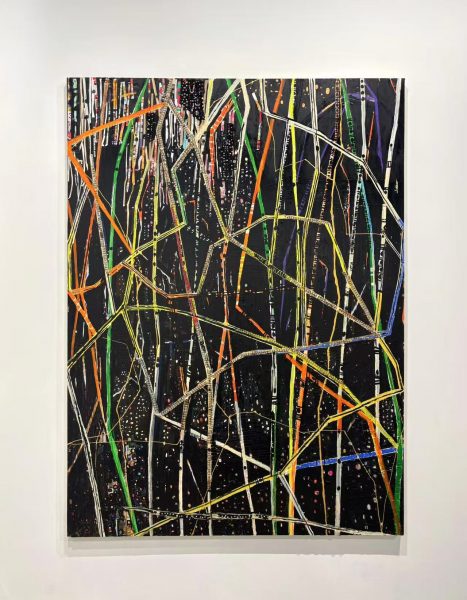
Krisanamis is known for his use of unconventional materials, from newspapers to cellophane and even dried noodles. His layered compositions reflect the fragmentation and sensory overload of urban life.
This recent collage on plywood condenses his signature vocabulary—twisting lines, bold bands of color, and moody tonal fields.
I Gusti Ayu Kadek Murniasih
Both of Them Make Me Crazy (2003)
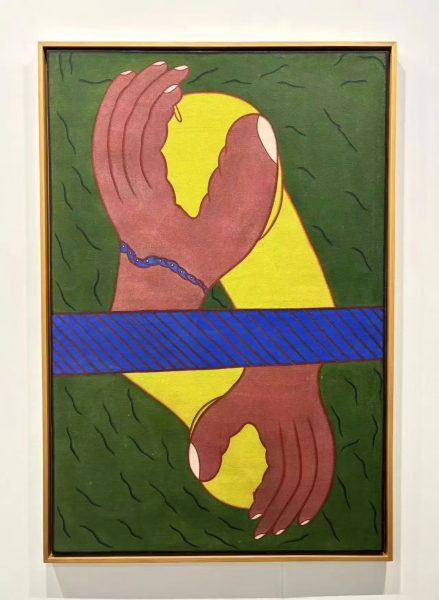
Working in Bali during the 1990s and early 2000s, Murniasih adopted a style reminiscent of traditional Pengosekan painting—bright colors, bold outlines, flat backgrounds.
Yet her subject matter is radically different: deeply personal, unflinching explorations of sexuality, desire, and trauma. In this work, mirrored hands grasp symbolic, gendered forms within a green field—both intimate and confrontational.
Huang Yuxing
The Subterranean Heart of Artificial Intelligence (2024–2026)
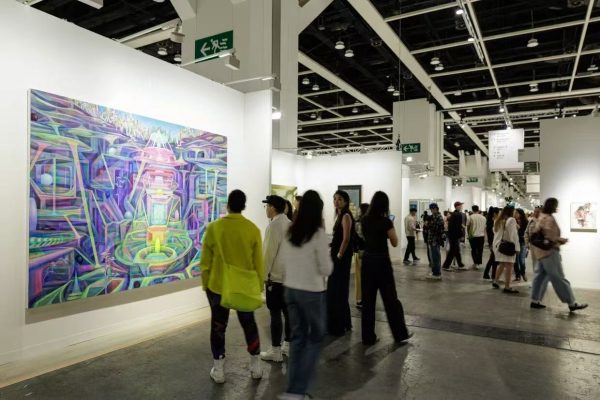
Huang Yuxing reimagines the hidden interior of data centers. His large-scale painting depicts a glowing underground world where electric colors surge through layered terrains and channels.
Rooted in meticulous gongbi painting techniques, Huang pushes landscape tradition into a speculative, technological future.
Lee Bae
Brushstroke JV2 (2026)
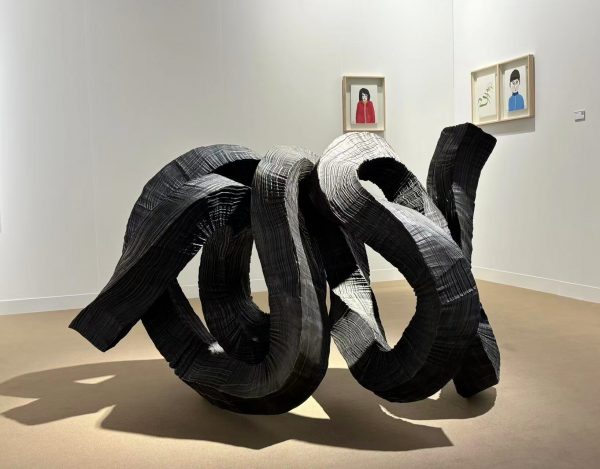
Lee Bae’s practice begins with charcoal, valued for both its expressive quality and cultural resonance.
In this work, a single brushstroke gesture is translated into bronze—extending a fleeting motion into sculptural permanence.
Nalini Malani
Tales of Good and Evil (2008)
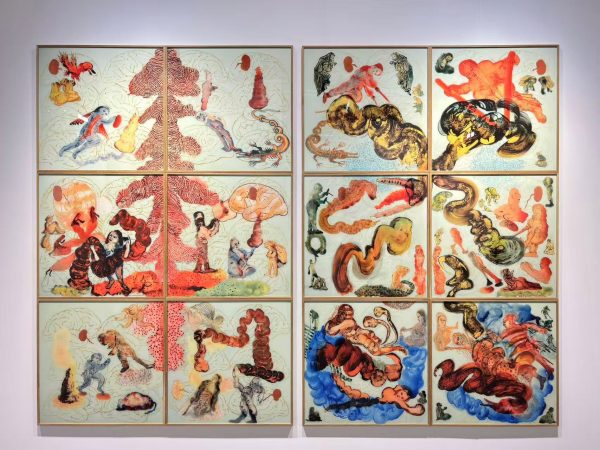
A pioneer of video art in India, Malani’s work is shaped by displacement, violence, and feminism.
This painting unfolds across a 12-panel grid like a mythic dreamscape, where hybrid figures drift through softly colored zones, linking narrative fragments from one panel to the next.
Tishan Hsu
skin-screen: revealed (single 3) (2026)
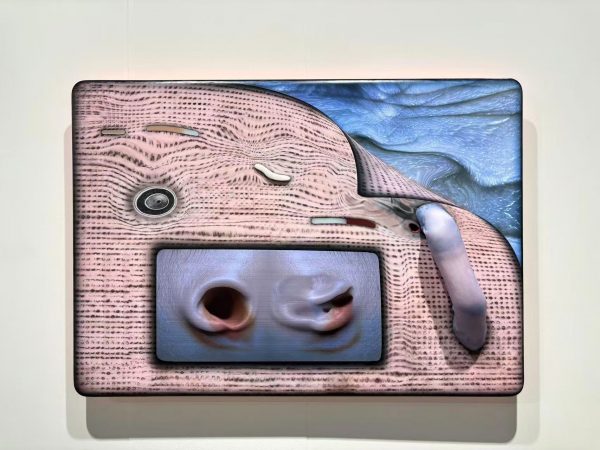
Long before smartphones and AI, Tishan Hsu anticipated the merging of body and technology.
In this multimedia work, a fleshy surface peels back to reveal hidden layers beneath, with cavities and protrusions evoking fragmented bodily forms.
Ding Yi
Appearance of Crosses 2025-11 (2025)
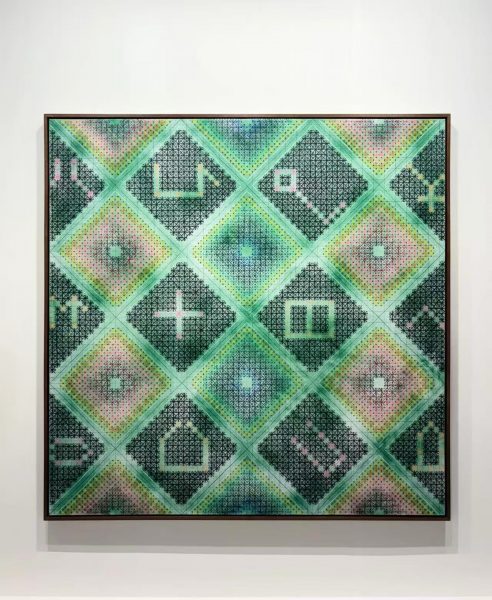
For nearly four decades, Ding Yi has explored the simple “cross” motif.
In this work, thousands of “+” and “×” marks accumulate into a vibrant, shifting diamond pattern—systematic yet far from mechanical.
Mire Lee
Tentacles for Open Wound (studio prototype) (2025)
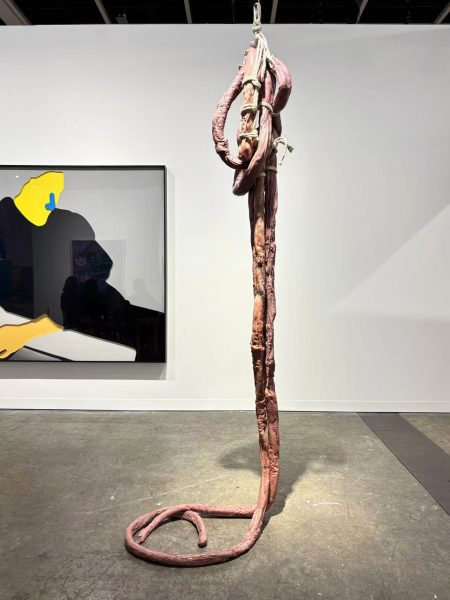
Known for visceral, industrial installations, Mire Lee explores tension between eroticism, fragility, and decay.
This suspended work echoes her monumental installation at Tate Modern, where silicone tentacles and dripping surfaces created a haunting “skin factory.” Here, it appears as an early prototype of that immersive environment.